
Machine Consciousness will not be Human
We need to stop thinking that they need to be the same

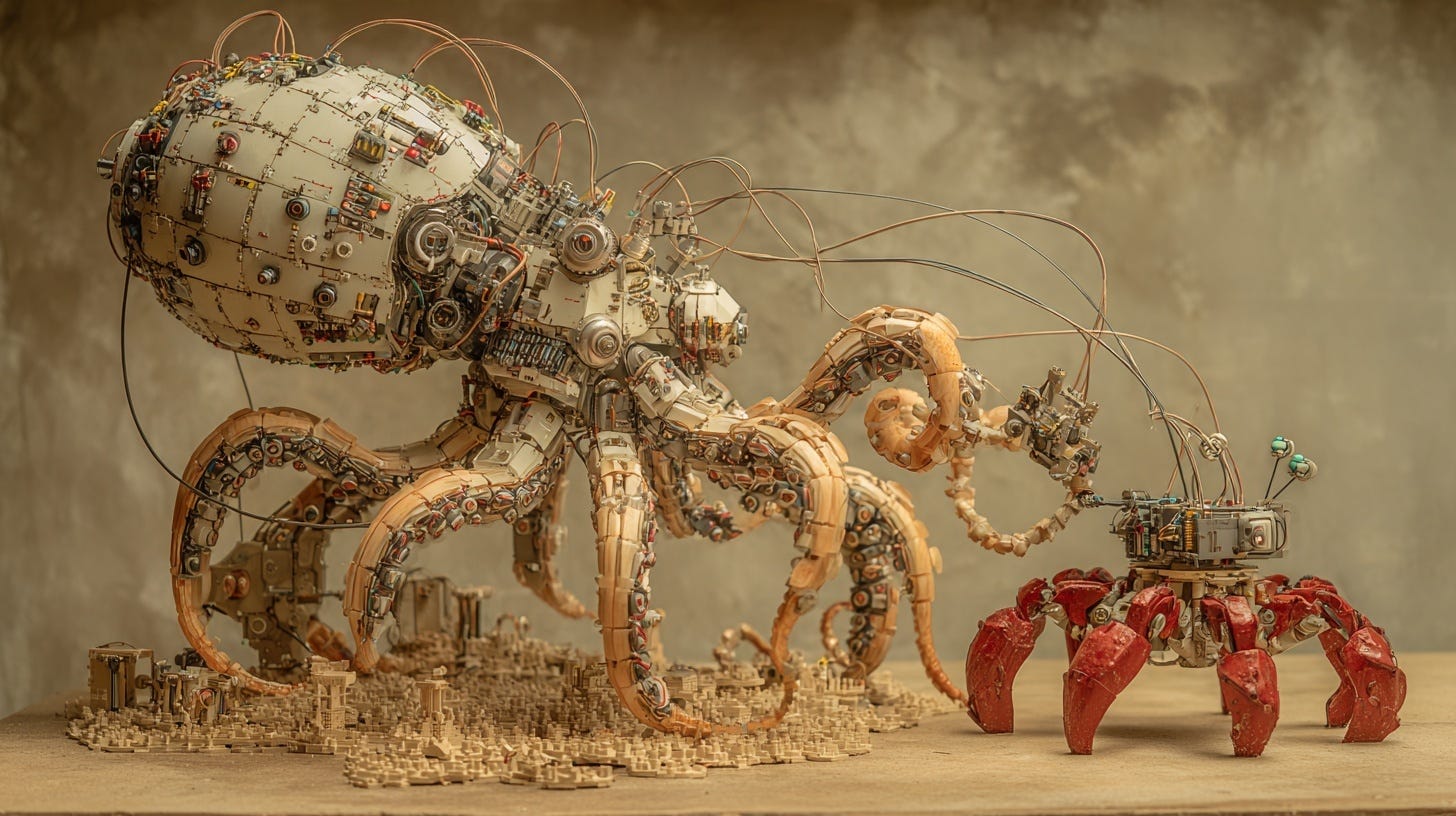
Imagine, if you would, your own consciousness. I am sure it is a truly marvelous thing, but it is something that I will never be able to experience, locked as I am within my own stream of consciousness. Yet, I am sure that you would be very happy to agree that, while your consciousness is unique, distinct, and oh-so-very special, it is a member of a larger set of consciousness, one that we can call human consciousness.
However, human consciousness is not the largest group of conscious entities there can be. It is not too controversial to say that human consciousness is a subset of mammalian consciousness which, in turn, is a subset of vertebrate consciousness. In most Western nations, all vertebrates are seen to be sentient with the capacity for pleasure and pain. These valence feelings require phenomenal consciousness, so we can say that, at least in the liberal democratic West, society accepts that vertebrates are conscious.
But it does not end there. Some countries have passed legislation admitting cephalopods, decapods, or even honeybees to their list of sentient creatures. For the sake of argument, let’s presume these awfully kind and inclusive nations are correct in their assessment. This would put vertebrate consciousness within the set of animal consciousness.
This is, however, where the story stops as no nation, society, culture, or even academic consensus have ever progressed the circle of sentience beyond animals. Beyond the panpsychist fringe, the only entities that we have thus far confidently classified as conscious are animals (and not even all of them).
But before we talk about expanding the circle of confidently classified conscious characters to more than mere creatures, let us stay within the animal kingdom for a moment and ponder what consciousness means to us, particularly when we want to make any claims about who or what may be capable of consciousness.
When a lot of people talk about what it means to be conscious, even highly regarded academics, they first talk about our communicative and linguistic abilities. In short, we can talk, thus we are conscious. We even see this amongst all the people who call for an immediate consideration of AI models as conscious. “Look at how they communicate like us,” the AI-conscious advocates say, “if AI speak like us, surely they are conscious like us.”

But pigs and birds can’t talk, can they? Yes, they do vocally communicate in their own fashion, but Shakespeare they are not. Fish famously cannot vocalise at all, yet they are vertebrates like us and considered conscious. We could continue on listing all the differences between animal vocalisation and our use of language, but I believe it is not too uncontroversial to state that linguistic capacity does not entail consciousness.
We can also immediately rule out behaviour, as well. Just because something behaves like us, does not mean it is conscious. Yes, we share a lot of behavioural traits with other mammals and land vertebrates, but, again, look at the humble trout and how it behaves. We cannot, and should not, look at the behaviour of AI and make a determination of its consciousness based on that. Behaviourism will only lead to false positives.
An obvious counterargument is that behaviour and language are the symptoms and not the cause, which can point us in the right direction: the cognitive architecture. All vertebrates share an evolutionary history of cognitive development, as the predominant part of our consciousness had evolved before we first crawled out of the oceans. Thus, fish may not behave like us, but they are conscious (in a similar manner) like us because of our common ancestor.
This is absolutely true, and is one of the two core arguments to substrate dependence. After all, the only entities that we have been able to confidently classify as conscious are animals with whom we share a conscious common ancestor. But this isn’t true at all, because look at the beauty that is the octopus’s neural architecture.
Vertebrates and invertebrates split off on the grand tree of life long before consciousness ever evolved. Much like how the vertebrate eye and cephalopodian eye are examples of convergent evolution, so is our consciousness. Octopods evolved conscious cognitive architectures entirely separate from us. There is no shared evolutionary history between human consciousness and octopodian consciousness, yet that in no way detracts from their own unique cephalopodian expression of consciousness.

An octopus’s cognitive architecture, particularly how it is spread throughout the creature’s body, is a remarkable achievement of evolution, but it is doubly remarkable in how little it has in common with our own brains… yet still has the capacity for consciousness. It is an excellent example of how the structure of a cognitive architecture may change, while the function remains the same.
And so, let’s now move to the obvious next candidate for what may be classified as conscious in the near future: AI models. Before we even begin to advocate for new laws and regulations, let’s look again at what currently is conscious. We share the set of all currently conscious entities with creatures who can not speak, who do not act like us, whose behaviour is often entirely unlike us, and whose cognitive architecture ranges in terms of primitive homologs to entirely alien structures sharing only the most rudimentary of building blocks.
There is no reason to believe that AI models should be conscious because it shares language and behaviour with us, any more than it is unreasonable to suspect it cannot be conscious because its cognitive architecture does not share a structural homology with ours. Similarities and dissimilarities to human consciousness should never be a consideration when it comes to determining AI conscious, or whether AI deserve welfare protections or rights.
We need to remove any and all anthropomorphisms from our theories of consciousness. They do a disservice to AI consciousness studies as well to other biological conscious life. Our human expression of consciousness is beautiful and unique, but we need to remember that is exactly that: the human expression of consciousness. It isn’t the only expression of consciousness. Who knows? We may yet discover that AI consciousness is closer to octopodian consciousness than to human consciousness… but we can’t ever hope to test that, until we stop thinking of AI consciousness in terms of human consciousness.