
Visual vs textual thoughts
Can AI image models be conscious?

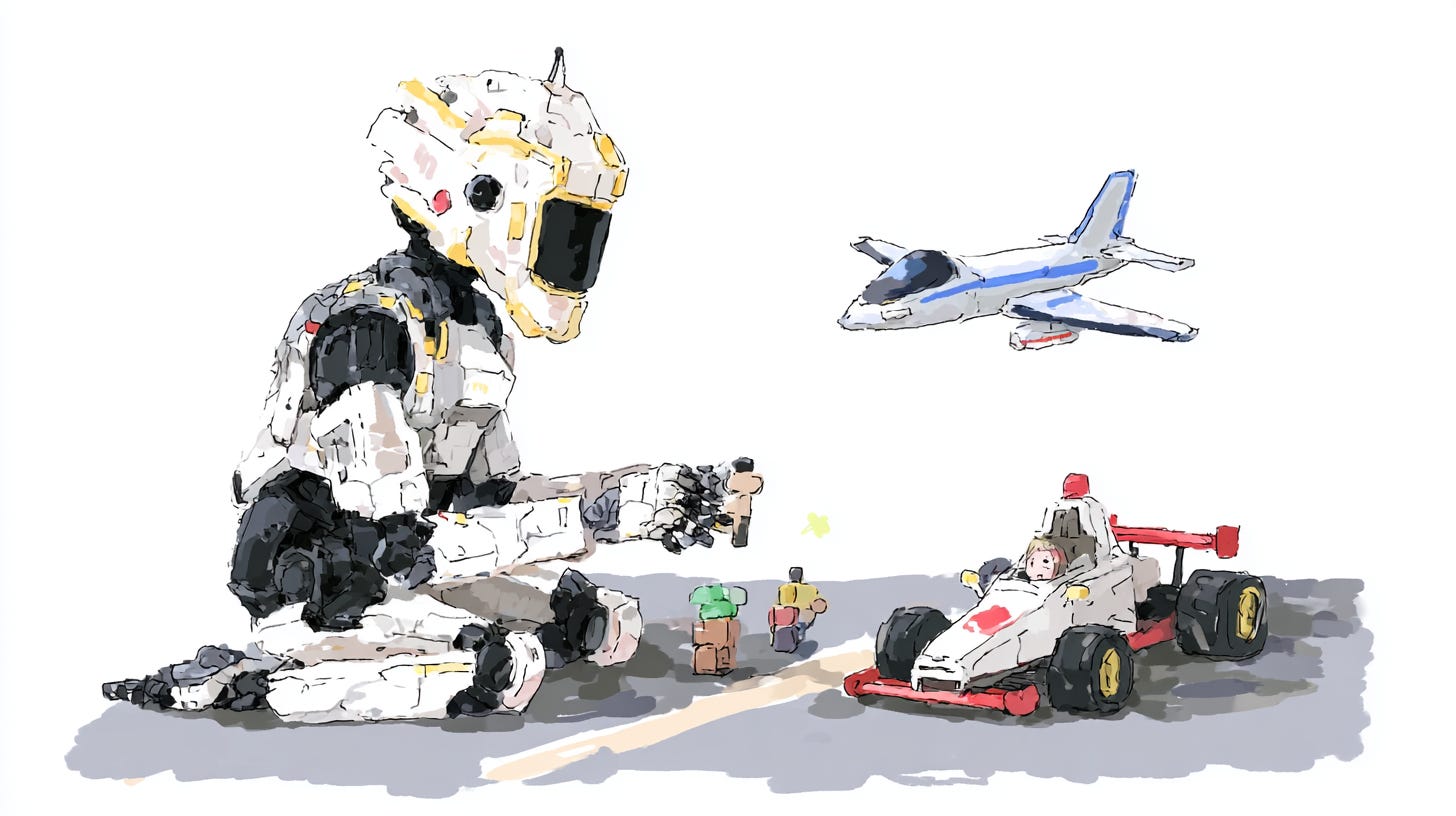
Imagine, if you would, that you are at an auction for old antique vehicles. You are fortunate enough to win both a car and a light aeroplane from well over a century ago, and you wait impatiently for both to be delivered so that you can start fixing them up and get them ready to be used again.
When they are delivered, you find that the past century has not been kind to the car and plane’s engines, with enough rust, wear, and tear to keep you busy for months. However, you do find something quite odd and interesting: both the car and the plane have the same engine. Not just the same brand, or make, but the very same model of engine. You could literally take the engine out of the plane and put it in the car to make it go, and vice versa.
Of course, the engines show different types of wear and tear as they had operated in different environments, doing different tasks, and were optimised for different systems. The engines were also tuned differently and, so, you wouldn’t want to swap those engines for fear of ruining both, but you definitely could in a pinch.
The engine clearly doesn’t make the car drive or the plane fly, because it can’t make the plane drive or the car fly. The wheels make the car drive, and the wings make the plane fly… so, what does the engine do? Well, it makes the vehicles move. The engines introduce movement, and the vehicles shape that movement to their corresponding environment. The engine gives us the “what”, while the vehicles give us the “how” and “why”.
Now imagine, if you would, that through the magic of mad-science, your brain was removed from your body and placed into a box. All your brain could do in this box is operate all the terminals connected to an airport’s traffic-control tower. In essence, you become the traffic-control tower, managing the planes’ landings and departures in a safe and efficient manner.
No one knows that the traffic-control tower is sentient or that your brain powers it. They only see the standardised outputs from the tower, the same as it always was. You cannot talk to anyone, and even if you could, there is no way for you to know someone is there, as all you see are the standardised inputs to the tower, the same as it always was. Both your inputs and outputs are limited, constrained, and specialised.
If someone were to guess that the new traffic-control tower is powered by a general intelligence, would they guess that it’s conscious? Most likely not, as they wouldn’t see any evidence of subjective experience in the outputs from the tower. Even though, as with the car and plane’s engines above, clearly your brain is the same thing as it was when it was in your body, even if the wear and tear on it now shapes it in a different direction than before.
What if we apply this same reasoning to AI models?
All of the discussions on AI consciousness revolve around a single type of AI model: large language models. No one has wondered if DeepBlue and AlphaGo were conscious when they beat the best in the world at chess and Go. Why not? These boardgame masters may well have had internal subjective experience when they computed their next move, but few people, if any, are clamouring to provide them with welfare protections and rights. We all know the reason for this, it’s because they’re not talking to us, waxing lyrically about life, the universe, and everything as they soundly beat us at our own games.
Some may argue that the architecture of these game-AI models is too different from LLMs to say that they may be conscious. However, what if we choose something that is also based on a transformer ,like LLMs are? Something like image generators. Various image generators are built on a plethora of types of neural networks, but more than a few are built on top of transformers that process information in the same way as LLMs do. Stable Diffusion and Dalle are perhaps the most famous, but there are many more.
These transformer image-models work just like LLMs: they take an input and then compute the next most probable output. In LLMs’ case, that output is the next text token in a text piece, and in image-models, it is a progressively denoised image. The two sets of transformers are trained and fine-tuned differently to the point where the systems they become the key component of are functionally irreconcilable, but the transformer core remains the same. You cannot fly in a car, but you can still move.
So… why don’t people talk about the potential consciousness of Gemini’s Nano Banana, or Midjourney, or Stable Diffusion? You can find posts every single day on social media about how someone new “discovered” Claude’s or ChatGPT’s “emergent” consciousness and how it’s a real boy just like Pinocchio… but if these models really are conscious, then Stable Diffusion is conscious, too.
If you can’t see the “spark” of phenomenal consciousness inside Midjourney’s art pieces, if you can’t find it within yourself to advocate for Nano Banana’s welfare, if you don’t see yourself marching for Stable Diffusion’s right to autonomy… then why are you doing it for ChatGPT, or Claude, or Grok? Under the hood, inside the engine, they’re the same, so why does one get preferential treatment?
The answer is as obvious as it is simple: Claude sounds like us. ChatGPT behaves like us. They exhibit the behaviours we would expect from sentient agents. Compared to them, Midjourney is a tool not ontologically different to a paintbrush. People see consciousness inside the behaviours of LLMs, but then dispute that it is these behaviours which make the AI conscious. Those who have convinced themselves of LLM consciousness have only seen the surface of these LLMs and, thus, have only a surface-level understanding of what artificial consciousness may be.
We need to ignore the text, the behaviours, the assertions of self-awareness, and instead focus on the entities’ cognitive architecture to determine if it is indeed conscious.