
Apophatic Consciousness
Knowing consciousness by knowing what it is not

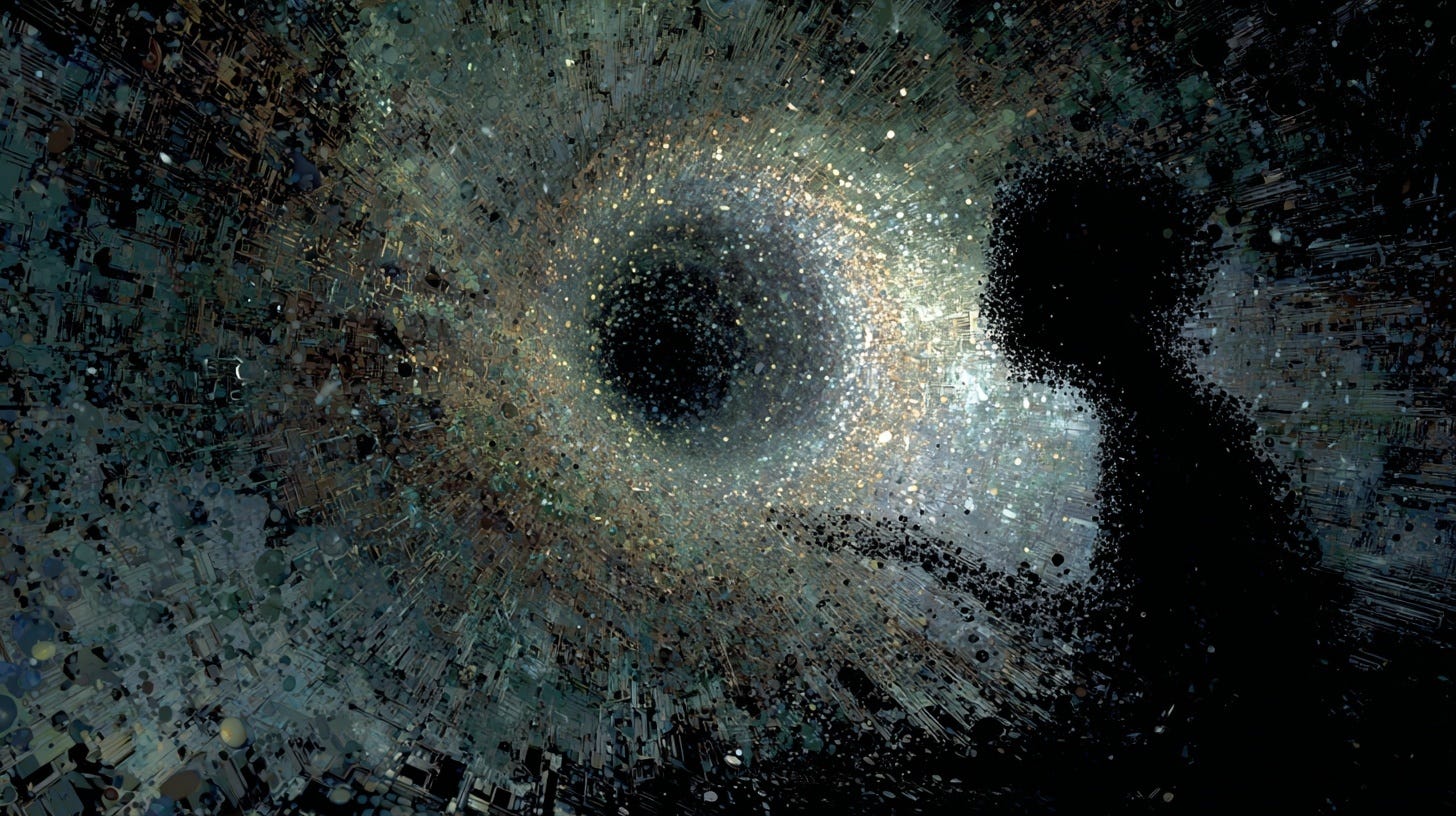
Imagine, if you would, your own consciousness. What is it that you are imagining? Descartes told us that we know that we are conscious because we are aware of our own thoughts, but being aware of a thought is quite a different matter to being aware of the awareness of that thought. And this only leads down into a recursive rabbithole of ineffable awareness of awareness of awareness.
We can experience all of this, but it doesn’t help us to articulate it in a way that can recognise it in someone (or something) else. After all, we cannot see into the indescribable felt sensations buried deep in someone else’s mind. We can only infer it, at best, by the behaviours that we observe.
This is the core reason why there are a million and one theories of consciousness, and why philosophers and cognitive scientists fall back onto poetic turns of phrases like Nagel’s “the way it is like to be” when describing consciousness. We cannot describe it, even to ourselves, and so it is impossible to agree on a formal measuring system for it. We all feel our own streams of consciousness in a different and unique manner; so, it should not be surprising that we each have a theory about what constitutes consciousness and how it works.
This is called cataphatic descriptions: describing something by stating what it is. It works for a lot of things, especially the measurable and physical because we can find a way to agree on it; but when it comes to the metaphysical and immeasurable, there is little to nothing to measure that we will agree on.
This is why I propose we should treat consciousness (at least, philosophically) the way we treat God: through apophatic descriptions: by saying what it is not. This allows us to draw a line around a set of things that could be consciousness and, slowly but surely, shrink that set down.
As a facetious example, we can say that consciousness is not my coffee mug, nor yours, nor anyone’s coffee mug. Even if you’re a panpsychist, you may believe that all coffee mugs are conscious, but not that they ARE consciousness. Thus, the line we draw around consciousness excludes coffee mugs. And we can do this for anything and everything else in the world, even ourselves. We can state that humans are not consciousness, to differentiate from the thing that is consciousness to the thing that is conscious.
But it isn’t just physical things that we can exclude from what consciousness is, but processes as well. We can categorically state that human behaviour is not part of consciousness, as other mammals and birds and whatnot are conscious without displaying human behaviour. In the same vein, we can rule out complex language for the very same reason. Octopods are considered to be conscious without even the ability to vocalise, read, or write.
The obvious question to ask at this point is that after all of this apophatic reasoning, what is consciousness, then? Well, that quite misses the point, doesn’t it? Apophatic descriptions are not intended to say what something is, but to rule out what it can’t be, which is why it is so useful regarding consciousness.

Instead, take anything you can think of that you believe should be part of consciousness, a prerequisite for consciousness, or a consequence thereof. Then, test your assumptions, either through logic by seeing if other entities already classified as conscious have these attributes you are considering, or through empirical tests if it is something that we cannot externally observe. Many people have tried to disprove theories, but we needn’t go that far. We can take each tiny thing that anyone can think of and either rule it out, or leave it inside the net of mysterious things which may or may not be part of what we call consciousness.
Apophatic descriptions can never pinpoint what something is; that’s simply impossible when it comes to metaphysics. There will always be something extra that we can think of that we cannot rule out. And just because we can’t rule it out doesn’t mean we must rule it in.
For example, is separation of thoughts and feelings part of consciousness? We can’t say. Everything that we know regarding conscious agents always do both simultaneously; even when you are awestruck by a phenomenal event, your brain still continues to process inputs and outputs, consciously and subconsciously. However, a priori logic points towards the conceivability and plausibility of pure phenomenality existing without further processing, especially when looking at small enough timescales. Thus, we cannot rule out the separation of thoughts and feelings, but that does not de facto mean consciousness separates the two, only that we cannot be sure… yet.

At first glance this may all seem like pointless philosophical naval gazing; however, it has real world applications. Everyone is talking more and more about AI consciousness, whether current models already have it, or even if it is possible for machines to be conscious at all. Apophatic reasoning allows us to rule out less-than-stellar measures that people are using when talking about AI consciousness, so that we don’t over- or underestimate the degree to which any AI, future or present, may be conscious.
For example, we can conclusively rule out human-like language behaviour as mentioned previously. Just because LLMs behave like us during conversations means nothing about whether they are conscious like us. We’ve spoken in previous Guidebook entries about the fact that many AI image generators use the same foundational technology as ChatGPT and Claude, yet no one worries about them being conscious. A classic case of overattribution in the former case and underattribution in the latter case.
This is not to say that apophatic descriptions are the only way to do things, but it does reduce the amount of false negatives and positives we encounter. What we should be doing is pairing this with cataphatic descriptions once we have tightened the net sufficiently. We know that all conscious processing is to do with perception, so we can say that the capacity for perception is definitely a prerequisite for consciousness. This is how I created the Building Blocks theory, by looking at what was left over to rule in after I’ve ruled out nearly everything possible.
And we can keep doing this, slowly expanding a core list of things to rule in, a massive list to rule out, the grey zone of attributes and characteristics that we lack the evidence to confidently rule in or out.
when i think about consciousness i sometimes think that this is smth that just cannot be defined by language just because language is a “bad” or poor tool for this task. it appeared later in our evolution, while consciousness has allegedly always been there. plus we can probably say that language is a feature of rational part of our brain, and consciousness is a feature of more ancient structures. so maybe we understand it deep inside on some level, which is not a level of linguistic concepts, just cannot express outwards. what would you say?