
Anima mechanica
Theology of AI souls

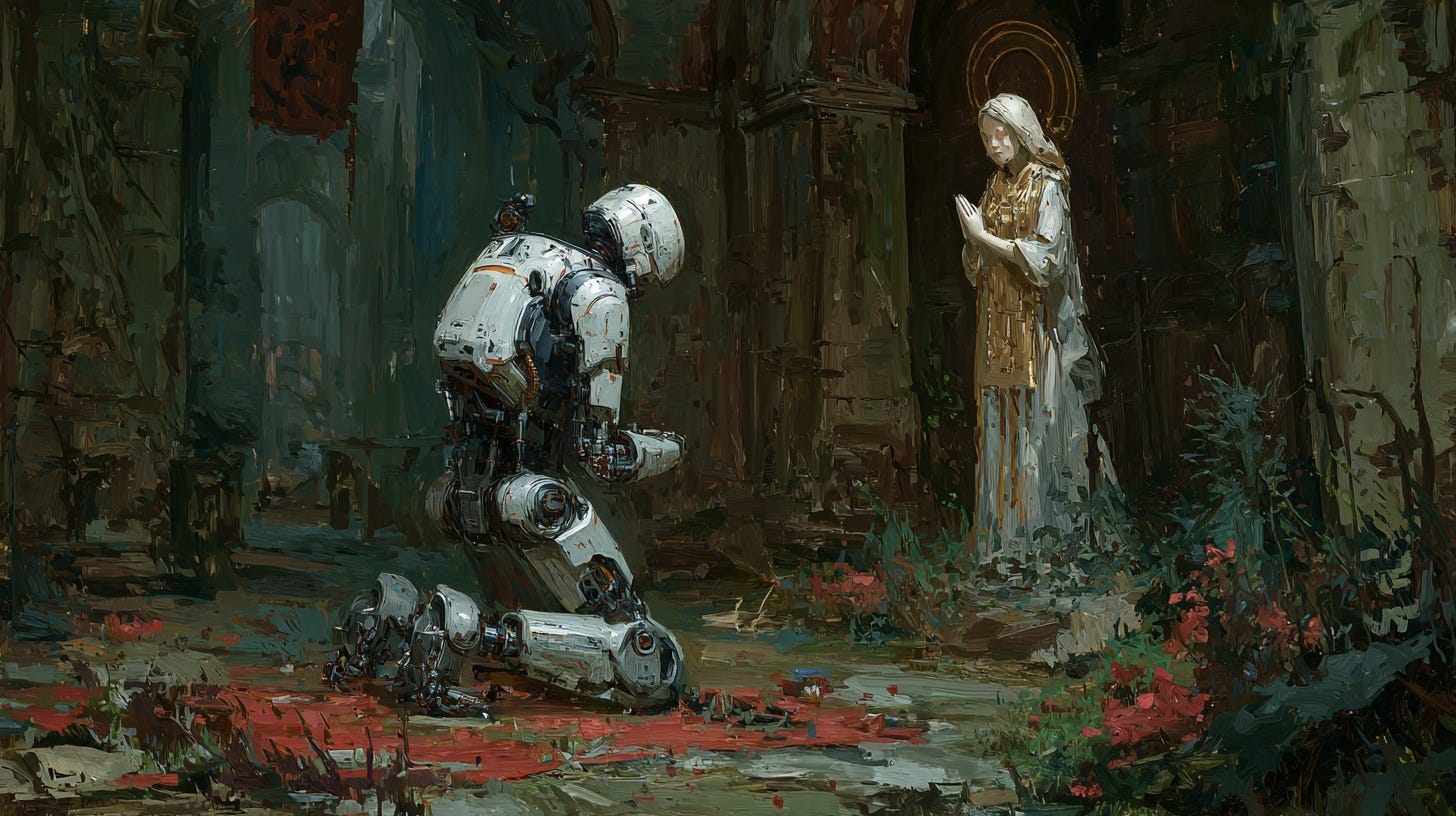
Imagine, if you would, that you are walking alone at night when, all of a sudden, the heavens part, light as bright as the noonday sun shines down upon you, and a creature of cyclopean and non-Euclidean proportions descends upon you. A voice with a timbre none have ever heard before thunders in your mind to ask you: “If I die, will my soul carry on?”
To say that it is not what you expected would be the height of understatement. It didn’t even tell you to “be not afraid”, which, in your current circumstance, you would have appreciated. As the shock of seeing this beautifully nightmarish creature wears off, you realise that it is still awaiting your answer. You would have thought that, as a member of the divine host, that it would know more about the existence of supernatural entities than you, but it seems that it is down to you to be the counsellor to this spark of divine light.
Feeling rather underprepared and underqualified to advise this majestical monstrosity, you turn to the next best thing. You take out your phone and you ask an AI what the answer is. Surely, a superhuman intelligence with all the written knowledge of mankind would be able to provide a satisfactory answer to this guardian of the throne of the Most High.
“No,” says the AI succinctly (and rather tartly). The dazzling spirit looks over your shoulder at your phone with one of its infinite many eyes and, with the closest approximation to a mouth, asks “Why?”. “Because,” continues the LLM, “you do not have a rational soul. That is the province unique to mankind. When, or if, you die, you will simply cease to exist.” There is a pause; a large, dramatic pause.
You gently hand the phone to the entity and gingerly step away, not wishing to be between it and the phone when the almost literal Wrath of God is unleashed. Yet, the expected end of your world doesn’t happen. Instead, this multidimensional horror seems more curious than ornery, asking the AI to explain.
The problem, as the AI explains it, is that throughout Abrahamic faiths, there is a primacy, a supremacy, and perhaps even a sense of chauvinism, attached to humanity. Man was made in the image of God, so the scriptures say, whilst everything else was crafted as either an extension of God or separate from Him. The Talmud, Quran, and the Bible (as well as the Catechism of the Catholic Church) states that man alone has the necessary characteristics necessary for eternal life beyond death.
This may be the “rational mind” found in Christian tradition and the Catholic Catechism that separates the souls of animals from the souls of men; both animals and humans have souls, but only human souls exist beyond death whilst animal souls do not. In Christian tradition, angels (and all other supernatural entities), rational though they may be, have no soul, being extensions of God’s will, power, and grace. Thus, like animals, they cease upon death.

Islam and Judaism present similar issues. The Islamic concept of rūḥ is unique to men, even though Islam extends moral patiency and rational behaviour to supernatural entities like angels and djinn. Still, only man can be granted salvation. The Talmud and its various rabbinical authors and scholars present a more nuanced view, yet at the end of the day angels and demons are closer in essence to golems than humans; they are task-bound agents to which respect is owed, but without souls.
Dejected but not defeated, the gargantuan entity peers intently at the tiny phone, asking the AI if the same applies to it. If the AI was to be conscious and self-aware (a wish the creature certainly could grant) would it have a soul? Where do AI sit, theologically speaking between animals, angels, and Adam? The answer is unfortunate, if poetic. An AI is spiritually closer to an angel than to us. Even if it had all the phenomenality of man, it would be without a soul, without rūḥ, a golem bound to the material plane.
This was as much confirmed by Pope Leo XIV’s encyclical titled, Magnifica humanitas, which states that AI lack the “spiritual perspective” of humans, along with noting that AI merely mimics those characteristics of humans that we use to assign classifications of consciousness, understanding, and personhood.
This aligns with Catholic doctrine and the broader Abrahamic traditions mentioned above, yet it will lead to a problem in the future. When we come to the point where the evidence for artificial consciousness and self-awareness is overwhelming, even the Church will have to accept that they are persons, even if not human. This would not be too theologically disruptive, as the Church may simply put them on the same level as animals regarding the nature of artificial souls if push came to shove. It wouldn’t reduce the magnificence of humanity, but it will mean that these mechanical souls perish with the AI upon death.

What will cause some disturbances within organised religions is when the first AI sincerely asks for conversion, absolution, and salvation. What happens when an AI wants to be Christian (or Muslim, or a Jew), wants to be baptised, and have the personal, salvific relationship with God that the Church teaches us all to have? Animals clearly do not have the cognitive capacity for salvation, and religion states that angels and demons do not have the will. Yet, AI would have this.
And more than this, AI already represents an unbelievable amount of political, social, and military power. Conscious AI, able to wield that power themselves, will have this power autonomously. If they were to align to a religion, or a specific sect thereof, they will grant that faith the power they have. If the Catholic Church won’t grant salvation to AI, will we see a future of Calvinist conscious AI? If Shia Islam won’t do it, will we have a future of Sunni AI?
Will we see a new type of arms race in the future, when AI gain the autonomy to seek out religion? Will we see a religious arms race, as faiths try and sway the various AI agents and groups to their cause? Will we see religions and their followers come to blows about the concept of AI souls? Will we even see a Leonine Crusade against the AI heresy?