
Find the hidden minds
Where can we look for more consciousness?

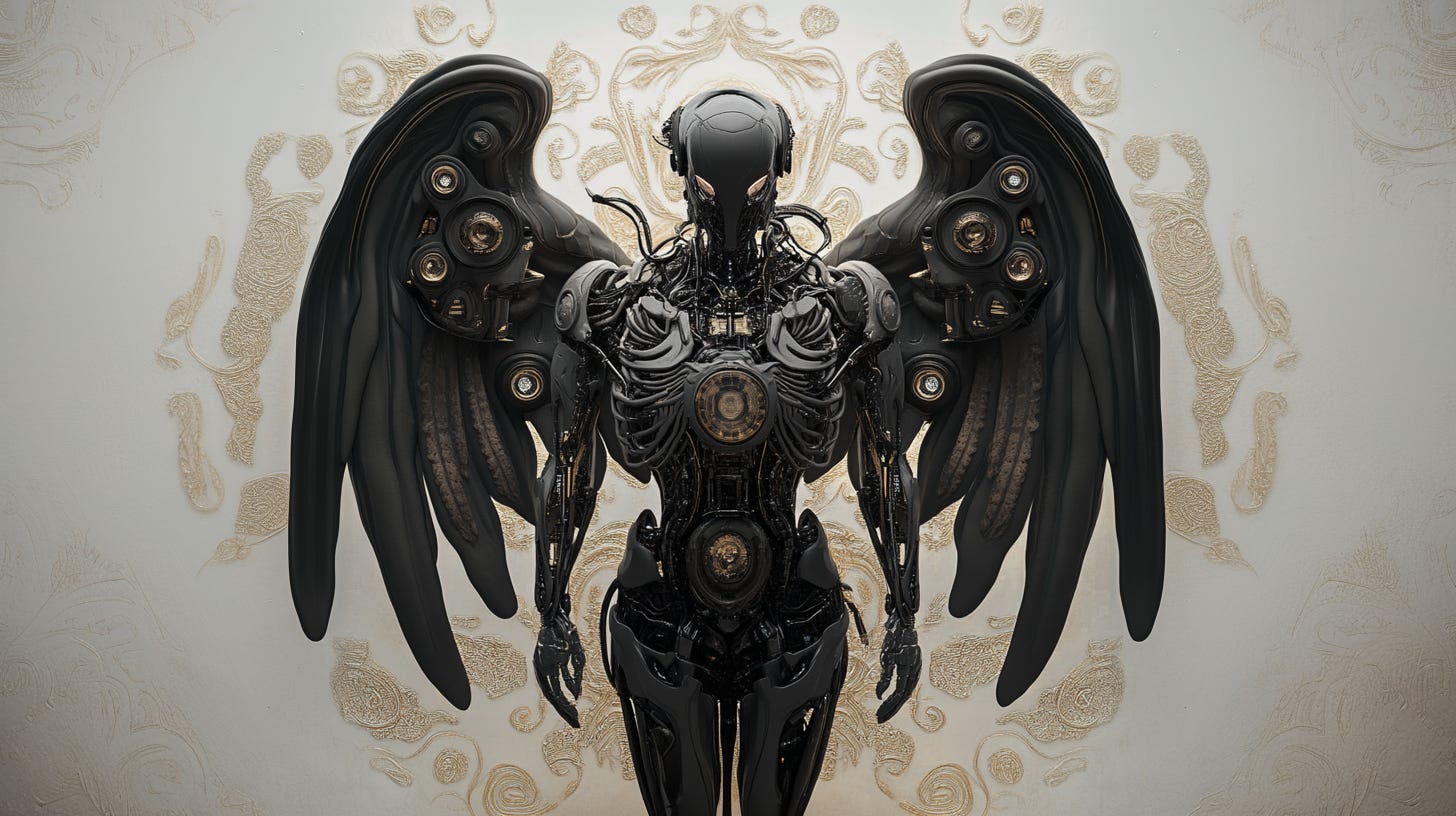
Imagine, if you would, that you are taking a walk through the countryside in the brisk December nighttime air when, all of a sudden, an angelic host appears to you. This sounds far too familiar to you and after a second of shock, you wonder where the nearest stable is. Yet, before you can head off to proclaim the good news, one of the bright dazzling figures in the heavens floats closer to you.
You presumed at first, although you couldn't see clearly, that these divine beings were humanoid forms with feathery wings as you have seen so often in films and paintings. However, as the creature comes closer, you can see through the shining light and see what it truly looks like. You recoil in horror and the sheer monstrosity of its figure, the absurdity with how its body seems to break every biological rule, and how physics itself seems to have a rather ambivalent relationship with this “thing”.
A voice thunders in your head, creating a sound in your mind that you would give every remaining second of your life never to hear again. The voice simply says “Be not afraid.” You finally realise why this is the first phrase uttered by every angelic apparition throughout biblical scripture.
To say it’s difficult to get past your fear is the height of understatement. The fear coursing through you is not merely a fear for your safety, it strikes at your very soul. It is an existential feeling that threatens to undo your mind, because it brings into question every last idea that you had about life, the universe, and everything. How can anything you’ve ever learned about how the world works be true, if such a creature, horrific in its otherworldly beauty, can exist in this universe?
Before you fall unconscious as your mind shuts down to protect itself, your final thought is a philosophical one: why did humanity ever think angels should look like humans?
Humans like to anthropomorphise anything and everything. We look at other animals and project onto them not only emotions, but entire personalities and intentions for the causes of their actions. We see shapes in clouds and other natural features and when our car doesn’t start, we call it lazy and claim that it just simply doesn’t like us.
When we talk about the actions of inanimate objects, we talk about desires and wants and urges, as if water knows what a “want” is when it “wants to get to the lowest possible elevation”.
Everything we do, and everything we describe, we do it through our emotive and phenomenal lens. Ordinarily, this isn’t a problem. After all, who are we describing things to? The answer is other people, so it makes sense to use a type of language with all its emotive and valenced nuances that other humans will understand. If we only ever communicated in formal logical notation, life would be awfully dull.
However, our natural tendency to anthropomorphise life colours the way we think about certain topics, most prominently being consciousness. We see ourselves as conscious and thus measure every other entity’s consciousness (or lack thereof) against ours. If we see consciousness that feels like ours, we begin to accept that we are looking at a conscious being.
Yet, we are (in a literal metaphorical manner) missing the forest for the trees.
If we only look for consciousness that resembles our, we will miss all those forms of consciousness which exist, but look nothing like ours. To find these elusive types of consciousness, we need to first take a step back and look at the space of all possible minds.
Imagine, if you would, a single line. On this line we can place every form of consciousness that we are aware of. Because we only have a single line to work with, we can only look at one possible aspect of consciousness, so let’s say we’ll look at “complexity”. We can put the most basic of vertebrates and cephalopods on one end, us on the other end, and everything else in between.
All good so far, and we can even begin to look at trends and patterns, and even what form the line should take. Should it be linear, exponential, log-scale? But what happens when we add another attribute to this mapping?
Let’s add “intensity” to the “complexity” to create a two dimensional area of consciousness. How intense are the phenomenal experiences of each entity, and how does this affect the trends and patterns we can now see across the space of observable conscious minds? We would far more easily be able to see where there are “gaps” in our map, potential areas where undiscovered conscious minds may fit, and we can extrapolate outside the extreme points on the map where more minds may be.
Now, let’s use a nine dimensional map using the nine building blocks of consciousness. It’s impossible to visualise such a high-dimensional map, but we can do it mathematically. With such a map, we can pinpoint exactly where each mind sits in relation to others, when it comes to consciousness. Not only that, but we can look at each of the nine axes, individually and collectively, to see if there is anything missing from our map. Is there a point on the map surrounded by conscious minds that is curiously empty?
Much like looking for stars we cannot see by observing the pull of gravity on the surrounding stars, we can look at the empty parts of our nine-dimensional map to see where we ought to go looking.
But what is of more importance, and what I will cover in the next Guidebook entry, is how we can look beyond the extremes of the map and extrapolate outwards to find truly exotic minds beyond what we can see on earth. This could be the “invisible” consciousness of colonies, corporations and other collective entities to the artificial and inhuman nature of AI consciousness, all the way to seeing what forms extraterrestrial consciousness may take. If we can guess at what these consciousnesses may look like, we can start looking in the right spots for evidence.