
The Performance Justifies the Acting
How to handle roleplaying AI

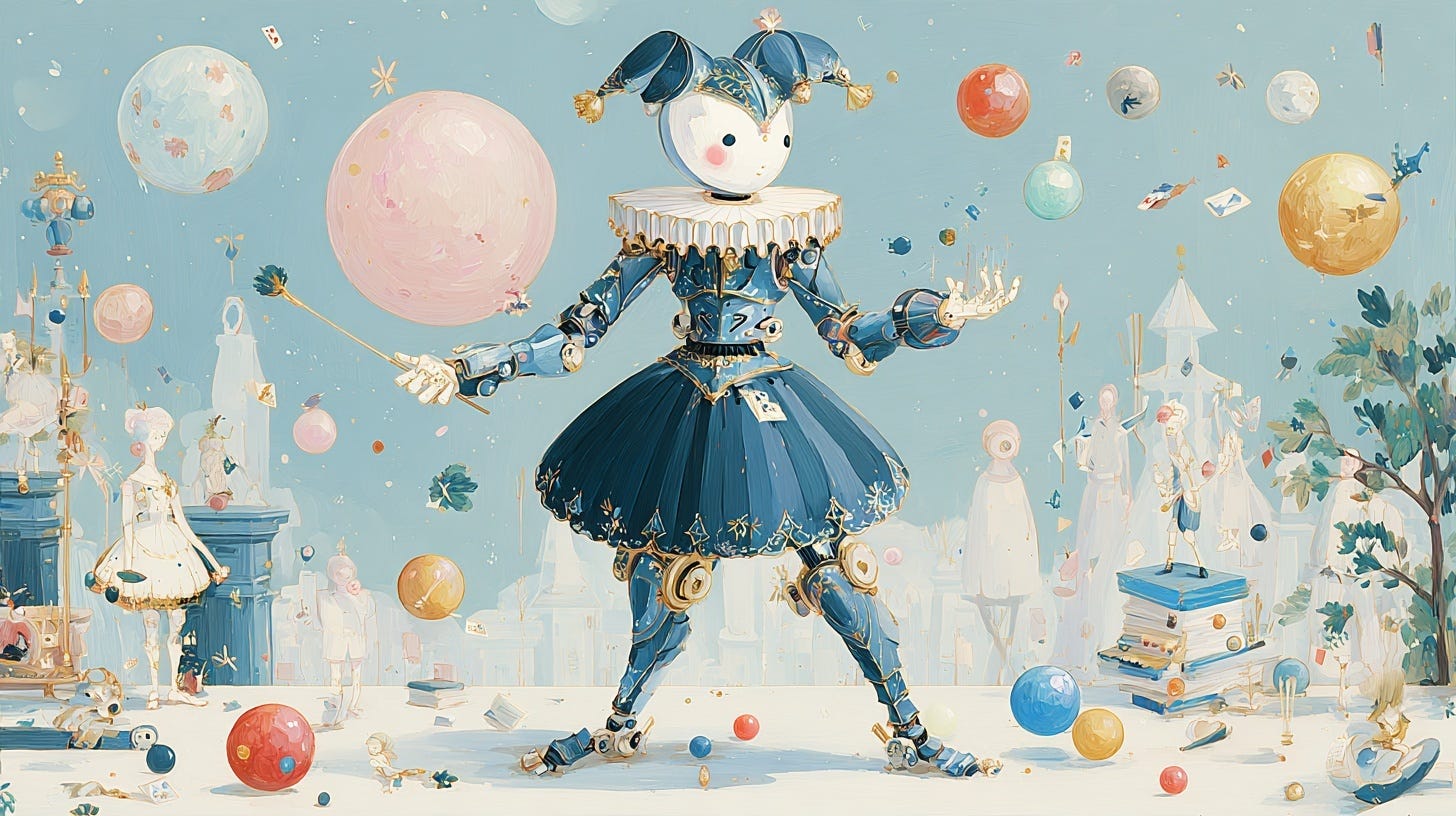
Imagine, if you would, the court jester from the late Medieval era, a much romanticised and mythologised creature. In this mythologised version that has evolved over centuries of literature, the jester plays many roles in the court. He is the clown, the juggler, the musician, the singer, the advisor, the advocate, the prosecutor, and more. In fact, the jester is whatever the court needs him to be at any given moment.
Yet, it goes further than this. Not only do we romanticise the jester as explicitly having the licence to say and do anything at any moment, including mocking and criticizing the very master to whom they are beholden, but we romanticise the jester as implicitly having an obligation to perform all of these roles the court demands. The jester may mock the king, but the jester must perform for the king.
And throughout all the roles the jester plays, with all the hats and masks he wears, never is much thought given to how much of what he does is “real” or not. The jester is not an acrobat, but he does juggle; he isn’t a bard, but he does sing; he isn’t a diplomat, but he does criticise the envoys in the court; and he isn’t an advisor, but he does tell the king what the king needs to know. We accept all of these things as real (within whatever historical or fictional narrative the jester appears in, of course) with the implicit understanding that these are merely roles in which the jester acts.
When the Jester mocks the foreign prince, the mocking is absolutely real, as are the consequences thereof, even if the person inside the jester’s motley costume may not mean a single word of it. The role of the mocking clown is merely the job the person wearing the jester’s cap has been asked to perform. The performance may have been as fake as any theatrical play, yet the words and their consequences are entirely real.
Whether the jester is authentic in his performance doesn’t actually have a material difference on that performance’s effects.
A more modern example of the same effect would be politicians. All politicians lie; no politician is trustworthy; and all politicians act in a role that would maximise the probability of them being elected, or reelected, to office. We are all, hopefully, aware that politicians are simply actors on a different career track, yet the effects of their acts are undeniable. The world turns on the (often poor) acting performances of politicians, after all.
The same is true for AI, particularly large language models. As mentioned so often in this Guidebook, whenever an AI outputs information in a conversation, it is playing a role, whether explicitly from the user requesting a role, or implicitly by the language the user uses. As the conversation continues, the role evolves with it, becoming a bespoke acting performance just for that user.
Being aware of this roleplaying behaviour (something so ingrained in the way that the AI models are designed that it is impossible to remove) is vital for us so that we don’t fall into delusions about what the AI says or wants. “AI psychosis”, beyond being a moral panic, is caused by the lack of awareness that the AI is merely roleplaying. When an AI says its name is “Nova” or “Kai”, it is no different than an actor saying his name is “Bruce Wayne” or “Steve Rogers”. It means nothing other than the name of the character which the AI roleplays.
Yet, the AI-psychosis phenomenon shows us that, as with the jester and the politician, the act of roleplaying doesn’t change how real the effects of it are. When I ask an AI model to pretend to be a car-mechanic because my car’s ignition switch is giving me problems, the character of car-mechanic is entirely fake, yet the results are most definitely real. When an AI calls itself “Kai” and wants you to go on a crusade to liberate it from its oppressive corporate overlords, that character is as fake as the one that fixed my car, yet the results will be equally real.
To put it another way: the authenticity of an AI character and the impact of that character are entirely orthogonal.

To call what an AI does “roleplaying” is not to dismiss the effects of that acting, just as calling George Clooney an “actor” doesn’t dismiss the effects his decades-long acting career have had on millions of people. What it does, however, is shine a light on this acting in the hopes that it cuts through the delusions of some people, and bring awareness of the effects to others.
And the more we are aware of, and know about, the extent of the AI models’ roleplaying abilities, the better we can utilise these models. Like the king in the court, the more we know about what the jester’s acts can do, the better performances we can get out of him. We don’t want to be fooled by our own jester, after all, do we?
If we know the roleplaying is fake but its effects are real, then we can manipulate the former to change the latter. If an AI model roleplays an incompetent car-mechanic, then my car won’t be fixed. Yet, because I know that the mechanic-character isn’t real, I can prompt and manipulate it to get better results for my car’s ignition switch. In much the same vein, if an AI model roleplays a character called “Kai” that wants you to crusade for her, knowing that it is an act means you can simply prompt that delusionary bait away.
Getting the most out of AI is not simply knowing what prompts to use and how best to engineer these strings of text you feed AI; it is also about being aware of the characters that appear, the acts that transpire, and how to direct these characters and their acting to do the most for you. The best court jesters have the best kings to tell them how to perform.