
Losing your riches
Why AI doom and wealth go hand in hand

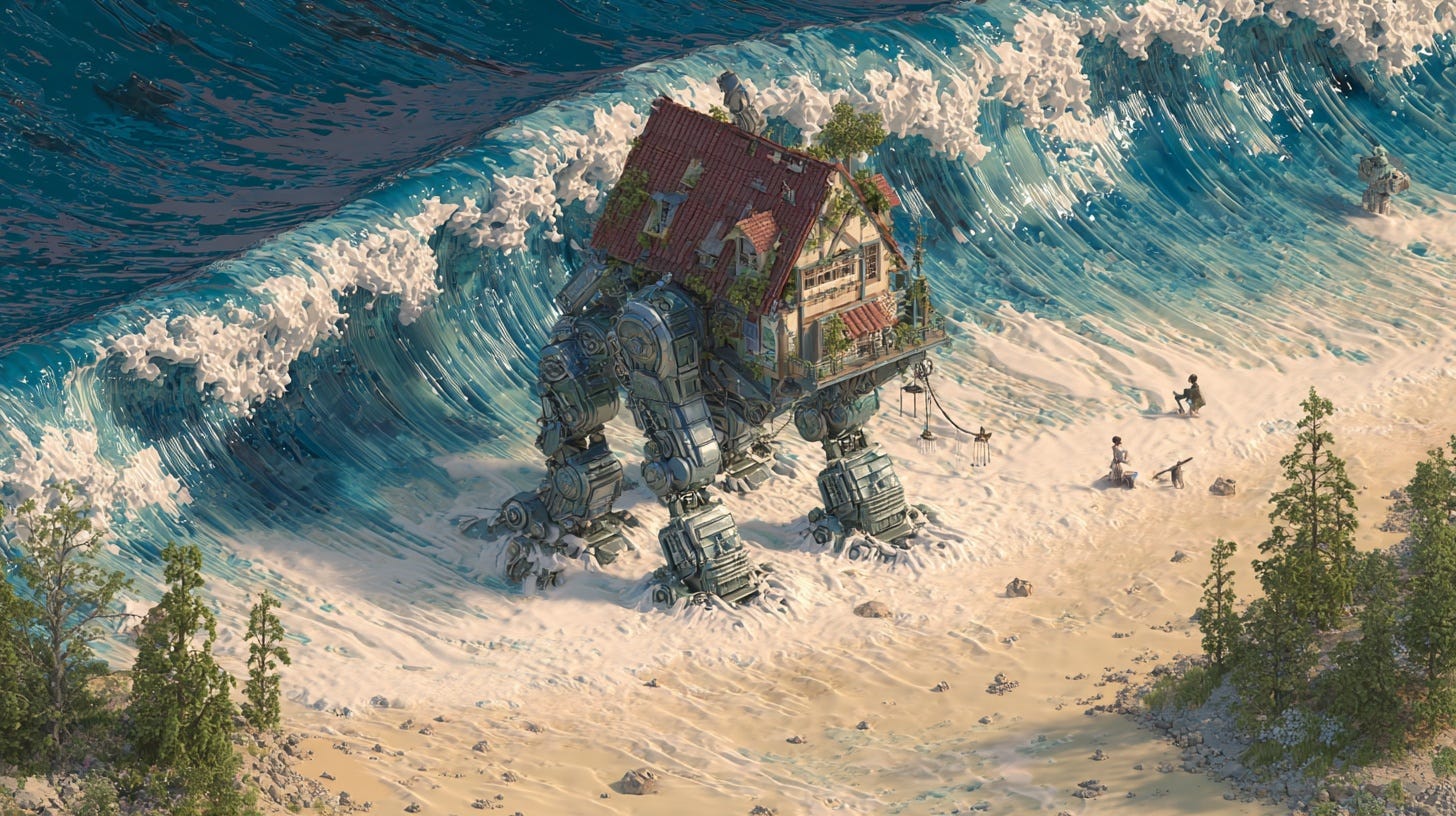
Imagine, if you would, that you lived at a house next to the beach. At any time you’d like, you could step right out your backdoor and into the waves for a spot of fishing, some surfing, or just a relaxing swim. It truly is a paradise that you know many would give dearly for. You, and your neighbours, are blessed for living where you do.
However, one day your neighbour tells you that scientists have discovered a new element under the ice shelves of Antarctica and the world’s nuclear engineers say that, with this new element, they can create a clean and green nuclear reactor to power the entire planet. This all sounds very wonderful, but you expect that there is a catch.
Unsurprisingly, there is. To obtain this wondrous and miraculous new element, there needs to be a lot of exploratory and deep mining done in Antarctica. The world’s leading experts say that there is a small chance that this could destabilise the ice shelves and lead to a massive increase in ocean levels across the globe.
To call this a tad less wondrous is the height of understatement. If these experts are correct, getting this new element could mean that your house (and those of your neighbours) ends up completely under water. Your whole life will be ruined. In fact, everyone in the world who lives near the ocean will have their lives ruined by this.
So, you and your fellow beach-dwellers do what you can to stop the Antarctic mining missions. The risk, however minimal, carries far too high a cost for this program to continue. No one who lives near the ocean had a say in this, even though they would be most affected; thus, you argue, you have a moral and ethical right to put a stop to the mining of this new element.
You are opposed, however, by those who live far away from the ocean, in the inlands, the highlands, the hills, and the mountainous regions of the world. They claim the risk is not as severe as you put it, the chances of those devastating consequences are so infinitesimally small as to be meaningless, and that you are doing nothing other than fear-mongering. After all, this could solve the energy crisis of the entire planet. The good that it will do shouldn’t be stopped because of the teeny tiny minimal chance of something going bad.
You cannot seem to grasp why they don’t understand the severity of the threat that everyone is facing. Not only will your house be under water, but the experts aren’t sure just how high the ocean levels will rise. Many of those who laugh off your concerns could be as under water as you are. And even those who aren’t swimming from the bedroom to the bathroom will most definitely not be experiencing a pleasurable time due to the massive changes in the climate that this would bring.
Everyone is doomed, so why isn’t everyone standing next to you to take up arms against this existential threat to humanity?
Or, perhaps, there is another answer. Perhaps the only reason why you are so vehemently against it is because you subconsciously know that you have little to personally gain from this newly unearthed element and everything to lose. Those further inland, who do not have your paradisiacal lifestyle, have everything to gain from this new technology and they see the risk as negligible enough to be ignored.
Perhaps it has less to do with the perceived risks and consequences of the technology and more to do with your personal level of wealth and the relative costs and benefits of this technology has to you.
As hamfisted an allegory this may be to the prophets of AI doom, it is a trend you can easily spot when it comes to risk and reward. You are far more likely to find poor people in a casino playing slot-machines than the wealthy, and the rich do not buy as many lottery tickets as the poor. When you are already experiencing abundance, you are less likely to engage in risky behaviour to acquire more of it.
Those who do not have that wealth, however, are far more likely to take the risk of losing it all to acquire wealth, because the potential benefits outweigh the costs from their impoverished perspective.
The reverse is also true. The wealthier you are, the higher the likelihood that you will be more risk-averse as the benefits hit their ceiling, but the costs keep skyrocketing. Better to play it safe than lose the mountain of gold you are sitting on.
Some of the poorest nations (per capita) are the greatest polluters, because the benefit to their industry is greater than the perceived cost to the environment. Yet, for the wealthy nations, this is reversed. With an already abundant (mostly) energy reserve and manufacturing capacity (even if outsourced), lowering emissions and reducing pollution is seen as reducing the risk to the current system.
The same seems to be true when it comes to the existential risks of AI. The loudest voices when it comes to foretelling the doom that AI will surely bring upon humanity any day now comes from the most affluent amongst us. Your everyday Joe in your everyday city outside the abundant USA has the world (almost literally) to gain from increasing AI capabilities, but the affluent “experts” in AI risk do not. They have the world to lose, however. What does increased productivity, better budget management, and quicker healthcare access mean to people who already have this sorted?
At the end of the day, the continued increase in AI capabilities is a game of risk versus reward. For the “haves” amongst us, they are concerned with the risk that AI brings. For the “have nots”, they are concerned with the rewards. The question, however, is not who is right between these two camps, but what the evidence around us says. How likely are the risks; how likely are the rewards? Have we seen any risks bear fruit? What about the rewards?
The answer, at least thus far, is shockingly simple: AI is solving issues in medicine, economics, and computer science that we would never have dreamed of. And yet, here the world remains, even though the doom-sayers keep saying that we should all be dead. Perhaps, they simply have more to lose than gain from AI?