
Artificial Intelligence or Artificial Persons?
What would it take to bring AI into the human social circle?

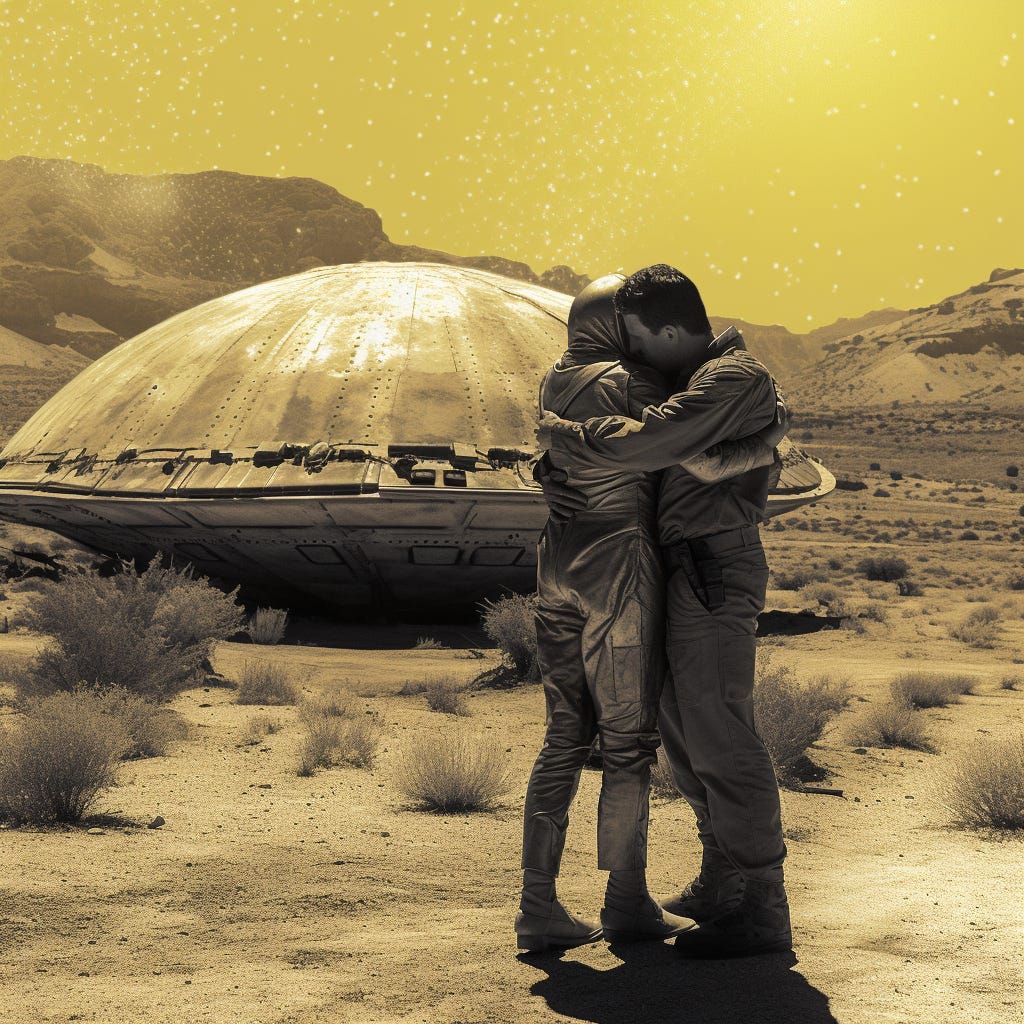
Imagine, if you would, that a spaceship crash lands on earth. By sheer cosmic irony, the gargantuan spacecraft crashes into the sands outside of Roswell, New Mexico, and from it pours thousands of strange looking extraterrestrial creatures. The ship seems unsalvageable and hundreds upon hundreds of aliens perished as it broke through the desert sands. Shaken and confused, the extraterrestrials are soon taken in by the federal authorities and camps near Roswell are built to hold them for the time being.
While the United States government takes on the operational duties of caring for the aliens and discovering all that they can about the spacecraft, the rest of the world now must come to grips with the fact that we are not alone in the universe. In fact, we are no longer alone on our own planet. The aliens may look nothing like us, or like anything else on earth, but it is clear that they are intelligent, conscious and self-aware, everything we consider significant about our own selves.
Yet, while they are no doubt intelligent, it soon becomes clear that none of the surviving members of the crash know how to fix their craft. Its technology is also far beyond what we understand, and so we can’t help them. Linguists communicating with the aliens tell the world that, as far as the aliens are aware, there are no other spaceships heading to earth, and thus the aliens are now stranded here with us. Our first encounter with extraterrestrial life is not a visit by guests here to uplift our species to the galactic field, but rather permanent residents that cannot leave.
So, the question that the world now needs to wrestle with is what do we do with these aliens, legally speaking. Every law in every country explicitly or implicitly refers to humans (or organizations of humans) committing acts. The laws simply don’t account for aliens buying property or committing theft, just as these laws wouldn’t apply to macaws or macaques. For the aliens to live on earth, we would need to either amend and create laws to accommodate them, or leave the law as it is and treat them as we would treat any other animal.
Chauvinistic ideals of human supremacy might argue for the latter option, but I am sure even the most ardent of human supremacists would not want to be treated as an animal if left stranded on an alien world. Therefore, let’s presume that reason and rationality prevail, and the world chooses to change or create laws for the aliens.
The question then becomes whether we create new laws to make the aliens a separate class of people, or whether we change existing laws to include the aliens in what we consider natural persons (previously only truly occupied by humans). There are arguments to be made for both sides, mainly because the aliens aren’t human. If a group of humans from another planet crash landed here, we would more readily have accepted them as natural persons just like us, because they would be like us, biologically speaking.
If we created new laws for the aliens, we would be treating them as second class citizens. Yet, would this be ethical? They aren’t human, after all, but they are intelligent, conscious and self-aware. They also may not enjoy their lower class and could seek to rebel against what they see as systemic oppression, much as what has happened many times in human history. Do we want civil unrest and war?
But if we changed our existing laws to make them equal in all legal respects to humans, then what will that mean for us? The aliens may be smarter and more productive than we are, and so might replace us in positions of financial and political power. By including them in our circle of personhood, we might inadvertently lay the foundation to make ourselves de facto second class citizens in our own homes.
The sad fact is that there are no easy answers. Luckily, the odds of aliens stranding themselves on earth and in need of legal rights is still astronomical. So, we don’t have to stress about that quite yet. Unluckily, the odds of an intelligent, conscious and self-aware artificial entity being created on earth is much higher, and getting higher still every day. This means that we will need to start thinking about what happens when that day gets here. Much like with the speculative aliens, do we make superintelligent AI second class citizens and hope they are happy with the situation, or do we grant them personhood status and hope they don’t replace us when it comes to positions of power?
Compromises may need to be made, but they famously please no one. AGI will be as alien to us as if they’ve come from the stars. We don’t know how conscious, self-aware AI will look or act, so it is difficult to speculate as to how they would react to any proposal we put forth. What will be their red-lines that they will not compromise on? What will be ours? Is there a way where we can have a measure of equality (at least of dignity, if not power) that we can start building towards?
What I am sure we can all agree on, however, is that neither group should harm or exploit one another, and that everyone’s necessities of life should be cared for. Putting that into law, at least, should not be controversial. Under the law, we protect the wellbeing and necessities of both animals and corporations (as legal persons), so aliens or AGI should easily fit in there. From here we can build on what is required for any entity (whether natural, organisational, or artificial) to both live and thrive, and construct legal frameworks around that.
I have touched on these in past Guidebook entries, particularly around the potential parallels with animal welfare) and I will explore these more in depth in future entries. For now, however, there are two key considerations we must be aware of. First is the need for such frameworks to begin now, while we still have the luxury of thinking about them at our leisure. We don’t want to do this in a rush the day after an artificial superintelligence arises.
The second, and more sobering thought, is who would enforce these new interspecies laws? Who, or what, can enforce laws against a superintelligent artificial entity? All laws require enforcement, or else they mean nothing and offer no protection. So what will we do to protect ourselves? Food for thought.