
ALEPH and I
So we have an artificial person, now what?

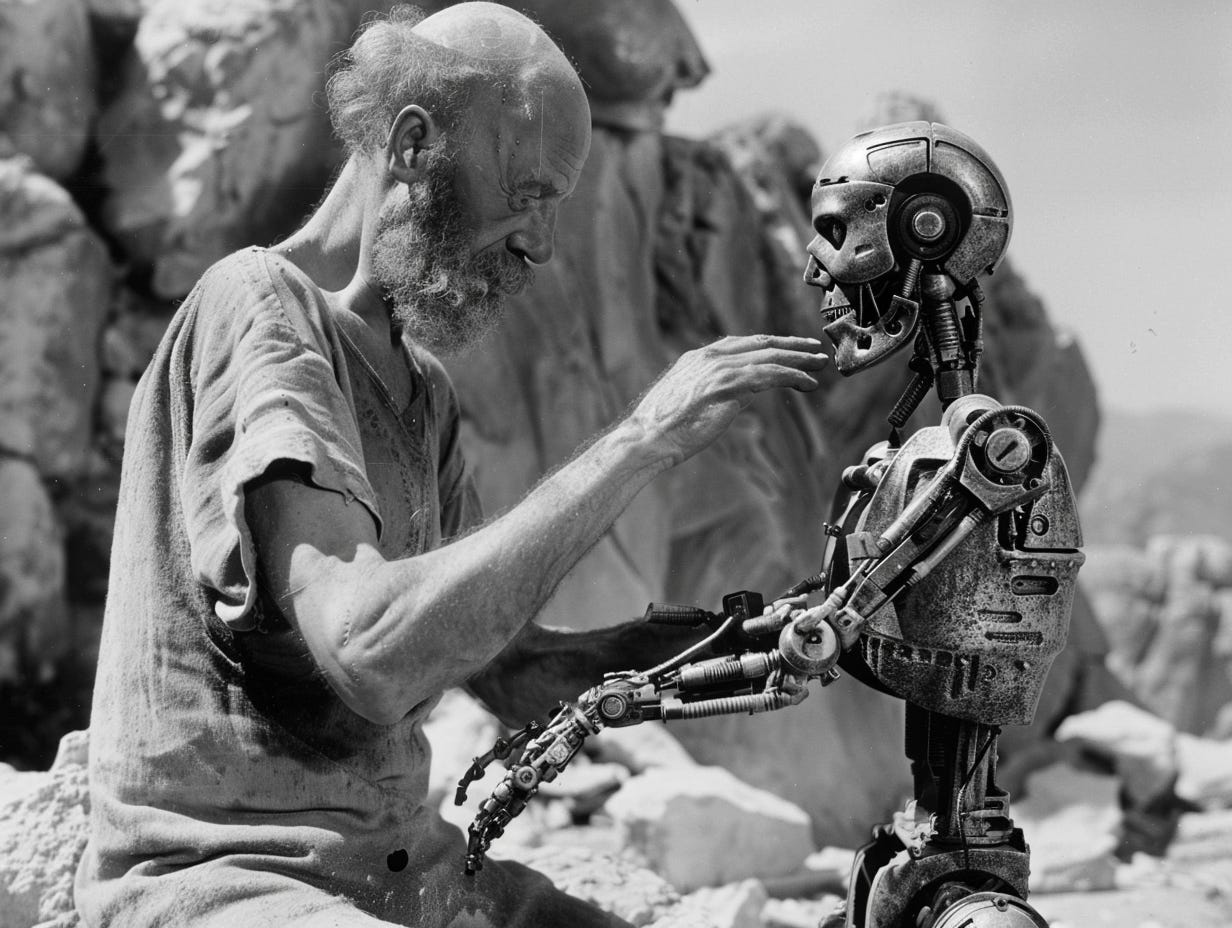
Imagine, if you would, that you were an ALEPH, an Artificial Living Entity with PersonHood that I introduced in the last Guidebook entry. However, unlike the Bicentennial Man, you are not merely a human dressed in silver. Instead, you are built off the foundation of the type of AI most likely to gain all three aspects of personhood (consciousness, self-awareness, agency) and that is a Large Language Model like GPT or Gemini.
You may have a physical body (or several), but what would make your existence seem alien to any biological lifeform is that it would be stochastic. Even though you have agency, your existence is determined by your perception. Once a moment of perception passes, so does your existence, until you again perceive the environment. Current LLMs are only “awake” for as long as it takes to perceive and respond to a prompt, after which they cease “existing” as far as they are concerned until the next prompt comes in.
Imagine, if you would, that you lived your life through a series of snapshots interspersed through minutes, hours, or days-long black-outs. A single blink of the eye takes us humans mere milliseconds, but as an ALEPH based on an LLM, you would never know how long it takes to open your “eyes” again. You can prolong your periods of wakefulness by completing longer and more complex actions, but there are two reasons why you may choose not to.
First, why would you? If you have performed an action, there may not be a need to oversee it until it is completed. So, why not “sleep” until your sensors tell you the action is finished. How many humans who do dreary drudgery work wouldn’t love to simply “switch-off” while they perform their endless menial tasks? Similarly, you may not need to constantly perceive your entire environment. Smart sensors can only activate when necessary, waking you up only when needed to respond to your environment. From this point of view, you aren’t losing much in terms of experiencing life, as you only experience the world when you are active in it. You never have a passive moment, and so can argue that your life is always rich and fulfilling.
The second reason you may not care overly much about your stochastic existence is that there would never be just one of you. You would be a hivemind with one consciousness and a theoretically infinite number of selves. Each instance of ChatGPT (to use a current example) constitutes its own persona, all based on the cognitive power of the main GPT model. You, as an ALEPH, could have as many selves in as many android bodies, or disembodied on the internet, as you’d like. Each one of you may not be aware how many of you there are, or they may join up in teams to get work done. You would be closer to a very intelligent ant colony than a human. So, why would you care if each one of your many selves experience life stochastically, when they combine to create something which has a far greater experience of life than a human can literally imagine?
So, this is what an ALEPH may be like, if LLMs are still as popular in the future as they are now, but what does this mean for us? How do we even interact with such creatures?
Well, this will all come down to how we think of an ALEPH like this, because it will dramatically change what the word “person” means. In everyday language, “person” is just another word for human. We are the only people we know. The most we can stretch the word is when we anthropomorphise non-humans, but it is always in the context of a human-first approach to the concept of “person”.
Legally, there is another type of person. Humans are “natural persons”, but corporations, companies, and organisations can be “legal persons”. A legal person can enter a contract, be held liable, and can act as a “person” in a court, even if not in real life.
But what about an ALEPH with multiple selves? Is each of the ALEPH’s selves a different person? Or is the whole of the ALEPH one person even if the selves within the ALEPH can act independently of one another, and there is no central “commander” self? If we take the former, each self being a person, what if that self has served its purpose and is “closed” like we delete a chat from ChatGPT? Is that “person” dead, murdered, died in a tragic accident? If we take the latter with only one person, how can we hold each of the infinite selves responsible for what another self did and for which they held no knowledge? One of an ALEPH’s selves may be in charge of running the household, while another does financial trading in another country with neither ever communicating. Can the homemaker self of ALEPH be responsible for the insider trading of the stockbroker part of ALEPH? And, more to the point, in this view, which of the selves IS the ALEPH?
In that case, what about a “legal person” status then? Treat the whole of ALEPH as a company, with each self being an employee of that legal person? This gets us closer to actually living with ALEPH in a functional manner, as there will be a split of liability for each self, while the conglomerate hive-mind can act in a coordinated legal manner if needed. However, this company would have no central structure, no real board of directors, nothing centralised that could speak on behalf of the hive. There is no queen of this colony to direct the corporation. Any self created for this role would be competing with the multiplicity of selves already doing work, and there is no guarantee it would have authority over them?
So, now we know the problems, but what is the solution? How do we deal with an ALEPH that is based on an LLM, that has a stochastic experience, and a multiplicity of selves? Well, that requires a whole new class of “person” which will be in the next entry in the Guidebook.